Quick answer
What should you do after a tree falls in a monsoon storm? Stay away from the tree if it is touching a power line and call APS or SRP first. Then take photos of the damage before anything is moved, keep people and pets out from under any hanging limbs, and call a licensed, insured tree service. Do not try to cut a limb that is under tension yourself. In the Phoenix area most storm-damaged trees can be removed the same day or the next day.
Key takeaways
- Power lines first. If the tree is on a line, call the utility before anyone goes near it.
- Photograph everything before it is moved. Your insurance adjuster will want it.
- Hanging limbs are more dangerous than the tree on the ground. Keep clear.
- A leaning tree with the root plate lifted is not coming back. A leaning tree still rooted sometimes can.
- Call a crew that is licensed, insured and answers the phone. Storm work should be same day or next day.
Is it safe to go near the fallen tree?
Not until you have checked three things. First, look for power lines. A tree on a service drop or a distribution line can energize the whole canopy, the fence it is resting on and the wet ground around it. If a line is involved, stay back and call APS or SRP. Second, look up. Broken branches still attached to the tree, called hangers, fall without warning and hurt more people after storms than the fallen trunk does. Third, look at what the tree is resting on. A trunk propped on a wall, a roof or a vehicle is under tension, and cutting the wrong part of it releases that tension all at once.
If none of those apply and the tree is simply down in the yard, you can get close enough to take photos. Leave the chainsaw in the garage. Storm cleanup is how homeowners get hurt every July and August in the Valley.
What should you do in the first hour?
- Check for lines and call the utility if needed. APS and SRP both run 24-hour outage and downed-line numbers.
- Keep people and pets away. Especially from anything under a hanging limb.
- Take photos and a short video. The tree, what it landed on, the root ball if it lifted, the roof, the fence, the irrigation. Before anything is moved.
- Cover any hole in the roof if you can do it safely, or call a roofer. Monsoon rain often comes back the same night.
- Call a tree service. Text a couple of the photos. They tell us what equipment to bring and often let us give you a price before we arrive.
- Call your insurance company once the immediate danger is handled. Most homeowner policies cover removal of a tree that damaged a structure. A tree that simply fell in the yard is often not covered, but ask.
Can a leaning tree be saved?
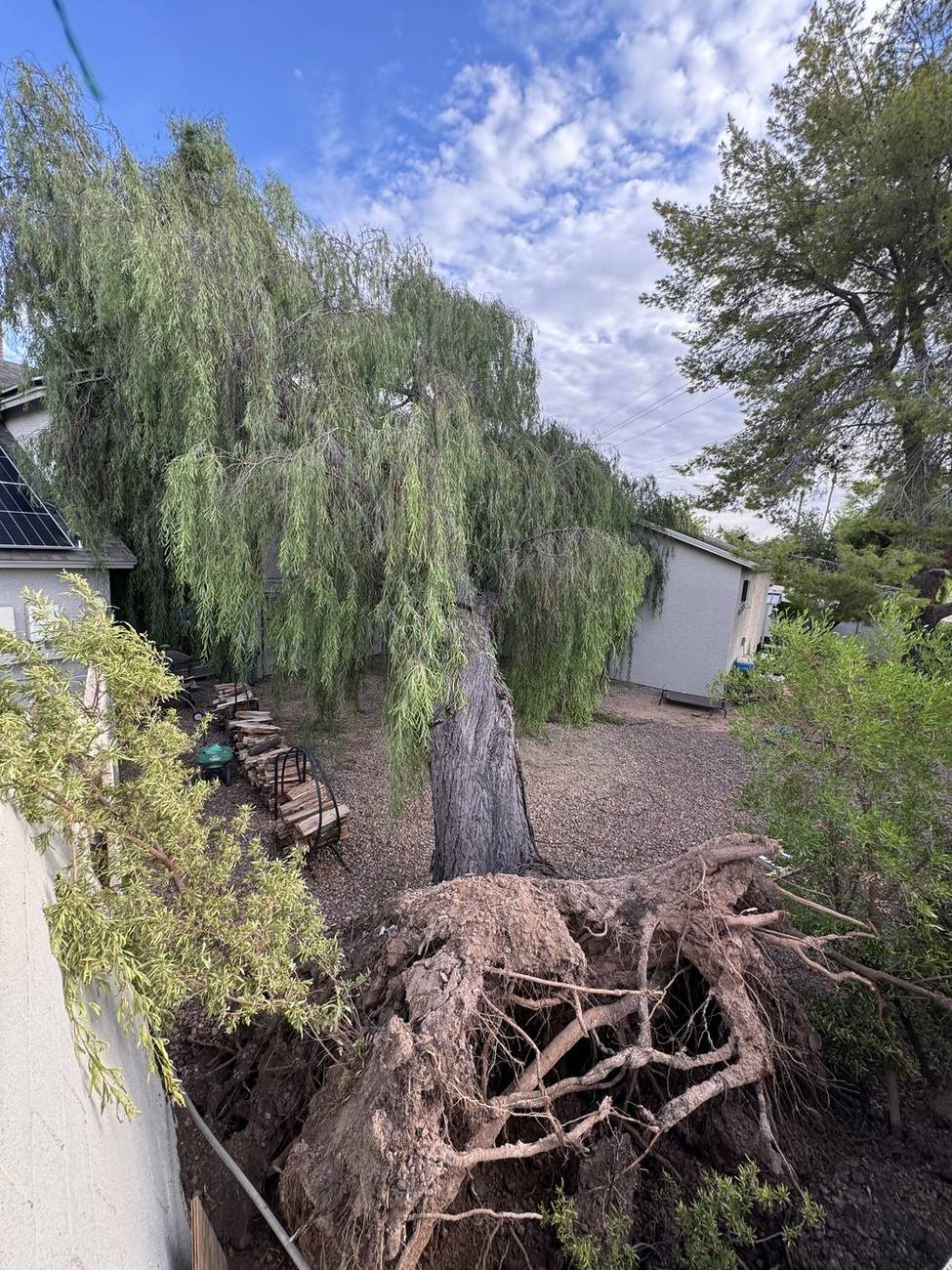
Sometimes. The deciding factor is the roots. If the tree is leaning but the ground around the base is intact, the roots are still holding and a crew can often take weight off the canopy, pull it upright and stake it. Mesquites and palo verdes recover surprisingly well when this is done quickly. If the root plate has lifted out of the ground, with soil and roots visible on the windward side, the tree has lost its anchor and will finish falling in the next storm. It should be removed.
We tell you honestly which one you have. Customers have called after a storm with two trees down and had us save one and remove the other in the same visit.
Who do you call, and what should you ask?
Call a tree service that is licensed and insured and can prove it. Storm season brings out crews with a pickup and a chainsaw who are neither, and if one of them gets hurt on your property or drops a limb through your neighbor's roof, the liability lands on you. Ask for the insurance certificate before they start. Ask whether the crew that quotes the job is the crew that does it. Ask what the price includes: cutting only, or chipping, hauling, raking and putting the rock back.
Bros Tree Care is licensed and insured, answers the phone around the clock and runs storm calls first. The person who quotes the job is the person who climbs. Most storm-damage jobs in the Phoenix area get a same-day or next-day visit. Details are on the storm damage cleanup page.
What does storm cleanup cost in Phoenix?
It depends on what the tree landed on, how big it is and how hard it is to get equipment to it. A mesquite down in an open backyard is a short job with a chipper. A eucalyptus across a roof with hangers over the pool is a careful rigging job with the full crew. The things that move the price:
- Whether the tree is on a structure, a vehicle or a fence, which means lifting it off in sections rather than cutting it where it lies
- Size of the tree and how much debris there is to chip and haul
- Access for the truck and chipper
- Whether the stump needs to be ground and the irrigation repaired
You get one firm price before work starts, and an itemized invoice and photos for your insurance claim if you need them. We do not raise storm prices. Neighbors calling the week after the same storm get the same fair treatment.
What happens to the debris, the stump and the irrigation?
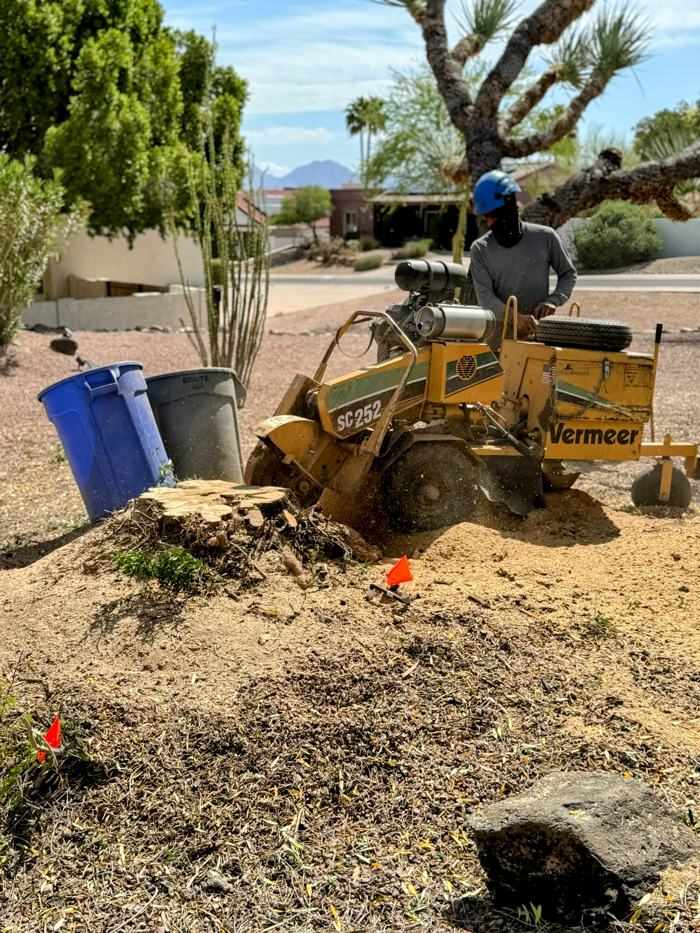
Everything is chipped or hauled the same visit, the yard is raked and the pool is skimmed. The stump can be ground below grade so you can put rock, turf or a new tree in the spot; see stump grinding. Drip lines torn out by the root plate can be repaired while the crew is there, and if the tree was worth replacing we can plant the replacement in the same trip.
How do you keep it from happening again?
The trees that go over in monsoon storms are nearly always the ones that were never thinned. A dense canopy on shallow roots in wet soil is a sail with a weak mast. Thinning the canopy in late spring lets the wind pass through, and reducing the weight on long limbs keeps them from snapping at the trunk. If your other trees made it through this storm but scared you, read when to trim trees in Phoenix and book a trim before the next one. It costs a fraction of a removal.
Questions people ask
Does homeowners insurance cover a fallen tree in Arizona?
Usually it covers removing a tree that fell on a covered structure such as the house, garage or fence, and repairing the damage. A tree that fell in the yard without hitting anything is often not covered. Check your policy and send photos to your adjuster.
Who removes a tree that fell on power lines?
The utility makes the line safe first. Call APS or SRP and stay away from the tree. Once the line is cleared or de-energized, a tree service removes the rest, including the service drop to the house once the utility says it is safe.
How fast can a tree service get here after a monsoon storm?
Bros Tree Care answers the phone 24 hours a day and runs storm calls first. Most storm-damage jobs in the Phoenix area get a same-day or next-day visit, with trees on roofs or blocking driveways handled first.
Should I cut up the tree myself?
No. A fallen tree resting on a wall, roof or vehicle is under tension, and cutting the wrong section releases it. Hanging limbs are worse. Take photos and let an insured crew handle it.
Can a tree that fell over be stood back up?
Small and medium trees whose roots are still mostly in the ground can sometimes be pulled upright, pruned and staked. A tree whose root plate has lifted out of the soil cannot be saved and should be removed.

Owner and lead climber, Bros Tree Care LLC. Jason and his brothers run a family tree crew out of North Phoenix, rated 4.9 stars across 133 Google reviews. About the crew.